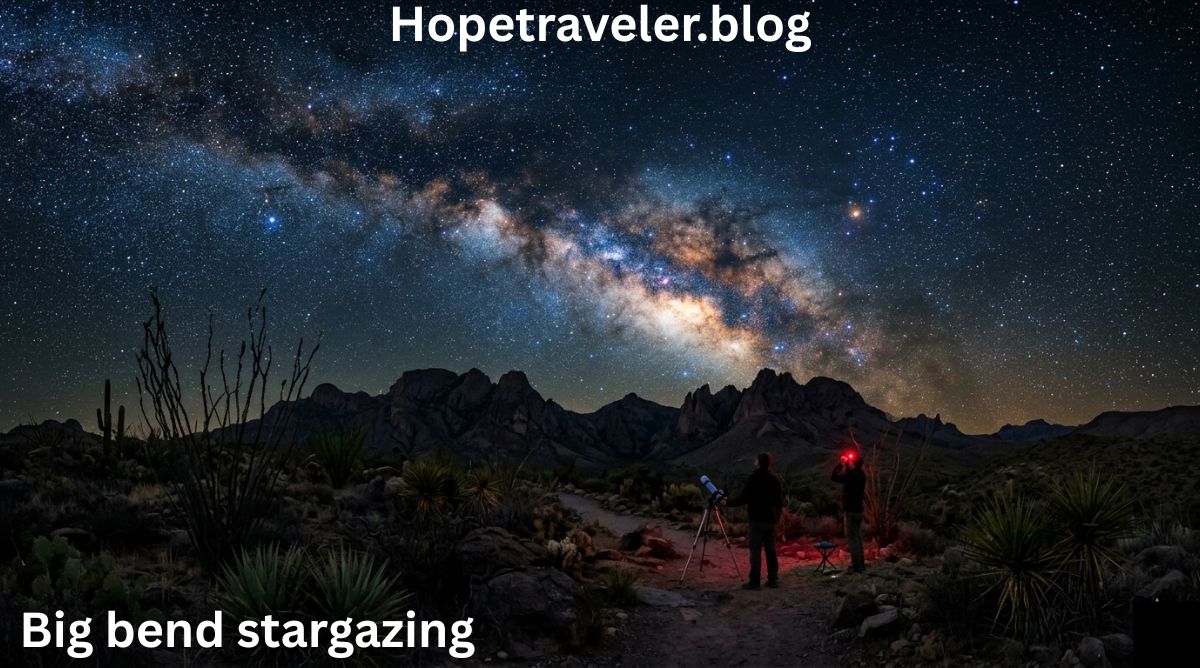
The vast, high-desert landscape of West Texas is home to one of the most profound natural spectacles on the planet: the untainted night sky. Big bend stargazing is not merely an outdoor activity; it is an immersion into a primeval environment where the darkness is preserved as a precious resource. Big Bend National Park, along with its neighbor Big Bend Ranch State Park, constitutes one of the largest protected dark-sky territories in the lower 48 United States. As of 2026, it remains a gold-tier International Dark Sky Park, a designation that reflects its commitment to maintaining near-zero light pollution. For travelers, astronomers, and seekers of solitude, this region offers a rare opportunity to witness the Milky Way with such clarity that it casts a subtle shadow on the ground, revealing the universe in its most authentic form.
The Geography of Darkness in West Texas
The exceptional quality of Big bend stargazing is primarily due to its geographic isolation. Located hundreds of miles from major metropolitan hubs like El Paso, San Antonio, or Chihuahua City, the park is shielded from the atmospheric “light domes” that obscure the stars in most parts of North America. The topography of the Big Bend region, characterized by the rugged Chisos Mountains surrounded by the sprawling Chihuahuan Desert, creates a natural basin that further isolates the area from distant artificial glows.
The air quality in this high-desert climate is another critical factor. With low humidity and minimal particulate matter, the atmosphere is exceptionally transparent. This lack of moisture prevents light from scattering, resulting in stars that appear as sharp, steady points of light rather than flickering or blurred objects. Biologists and physicists often refer to this as “astronomical seeing,” and in Big Bend, the seeing conditions are frequently among the best in the world. This clarity allows observers to see thousands of stars with the naked eye, whereas a typical suburban dweller might only see a few dozen.
The International Dark Sky Designation
In 2012, the International Dark-Sky Association (IDA) officially recognized Big Bend National Park for its extraordinary efforts in night-sky preservation. This was followed by similar recognition for Big Bend Ranch State Park and the nearby McDonald Observatory, creating a massive “Dark Sky Reserve” footprint. This designation is not permanent; it requires the park to follow strict lighting protocols. Most of the fixtures within the park—from ranger stations to campsites—use shielded, low-lumen, and warm-toned LED bulbs that direct light downward rather than upward into the atmosphere.
The commitment to darkness extends beyond the park boundaries. Local communities like Terlingua and Marathon have adopted dark-sky ordinances to ensure that their growth does not jeopardize the quality of Big bend stargazing. This collective effort is essential because light pollution can travel hundreds of miles. By protecting the dark, these entities are not only preserving a beautiful view but are also protecting the biological rhythms of nocturnal desert wildlife, which rely on the natural cycles of light and dark for hunting, mating, and navigation.
Seasonal Variations and the Best Time to Visit
While the stars are always present, the experience of Big bend stargazing changes significantly with the seasons. The most sought-after sight is the galactic core of the Milky Way, which is most visible from late February through October. During the summer months, the Milky Way arches directly overhead, appearing as a dense, glowing river of stars, nebulae, and dust clouds. However, summer also brings the possibility of monsoon clouds, which can occasionally obscure the view.
Winter stargazing in Big Bend offers its own unique advantages. While the center of the galaxy is not visible, the winter sky features some of the most famous and brightest constellations, such as Orion, Taurus, and Gemini. The colder winter air is often even drier than in the summer, leading to unparalleled atmospheric stability. Furthermore, the longer nights of December and January provide more hours of deep darkness. Regardless of the season, the best time for Big bend stargazing is during the “New Moon” phase—the window of a few days before and after the moon is absent from the sky. During a Full Moon, the lunar brightness is so intense that it washes out the fainter stars and the Milky Way.
Top Locations for Observation within the Park
Big Bend National Park covers over 800,000 acres, meaning there is no shortage of spots to set up a telescope or a folding chair. However, certain areas are renowned for specific viewing qualities. The Chisos Basin, located high in the mountains, offers a dramatic silhouette of jagged peaks against the star-filled sky. While the mountains block a portion of the horizon, the elevation provides a crispness to the air that is hard to beat.
For those seeking a 360-degree unobstructed horizon, the desert flats are the ideal choice. Locations like Sotol Vista or the many roadside pull-offs along the Ross Maxwell Scenic Drive provide a vast perspective where the stars appear to touch the ground. The Rio Grande Village area, on the eastern edge of the park, is also popular, though it is slightly lower in elevation. One of the most iconic spots for photography and viewing is the Balanced Rock area in the Grapevine Hills, where unique geological formations provide a stunning foreground for long-exposure star photos.
The Role of the McDonald Observatory
No discussion of Big bend stargazing is complete without mentioning the McDonald Observatory, located about two hours north of the park in the Davis Mountains. As one of the world’s leading centers for astronomical research, the observatory plays a pivotal role in public education. Their “Star Parties” are world-famous events where visitors can look through high-powered research telescopes and receive guided tours of the constellations from professional astronomers.
The relationship between the park and the observatory is symbiotic. The observatory provides the scientific data that helps the park manage its dark-sky status, while the park provides a vast buffer zone that protects the observatory’s sensitive equipment from light interference. For many visitors, a trip to Big Bend begins or ends with a program at McDonald, providing a scientific context to the sheer emotional awe of standing under the park’s dark skies.
Practical Tips for the Modern Stargazer
To make the most of Big bend stargazing, preparation is key. The most important tool for any stargazer is a red-light flashlight. Standard white light instantly ruins “night vision,” the process where the human eye adjusts to the dark. It takes the eyes about 20 to 30 minutes to fully adjust to the darkness of Big Bend, but only a second of white light to reset that progress. Red light allows you to see your path or your star map without losing your sensitivity to the stars.
Additionally, technology can enhance the experience. Various smartphone applications use GPS to identify constellations and planets in real-time. However, visitors must remember to turn their screen brightness to the lowest setting and use a red-filter mode if available. Bringing a pair of binoculars is also highly recommended; even a basic 10×50 pair can reveal the craters of the moon, the moons of Jupiter, and deep-sky objects like the Andromeda Galaxy or the Great Orion Nebula that are invisible to the naked eye.
The Impact of Satellites and the Future of the Sky
As of 2026, the global push for satellite-based internet has led to a significant increase in the number of satellites orbiting the Earth. These “satellite trains” are frequently visible during Big bend stargazing, appearing as lines of bright lights moving across the sky, particularly shortly after sunset or before sunrise. For many purists, these represent a new form of light pollution that cannot be managed by local ordinances.
Despite this, Big Bend remains one of the few places where the density of the stars is so great that the satellites are merely a small part of the background. Researchers in the park and at the McDonald Observatory are actively studying the impact of these constellations on both amateur enjoyment and professional research. The park continues to advocate for the “Right to the Night,” emphasizing that the view of the stars is a universal human heritage that deserves protection from all forms of interference.
Stargazing as a Form of Conservation and Wellness
In recent years, Big bend stargazing has been recognized not just as a hobby, but as a form of mental and emotional wellness. In a world characterized by constant digital stimulation and the glow of screens, the profound silence and darkness of the desert provide a much-needed “digital detox.” Psychologists have noted that the “Awe Effect”—the feeling of being in the presence of something vast and beyond our understanding—can reduce stress and increase feelings of connection to others.
Standing in the middle of the Chihuahuan Desert, looking up at light that has traveled for millions of years to reach your eyes, puts human concerns into perspective. It fosters a sense of stewardship, encouraging visitors to take dark-sky practices back to their own homes. By teaching people how to use better lighting, Big Bend serves as a catalyst for a global movement to reclaim the night sky in cities and suburbs across the world.
Conclusion
Big bend stargazing is a transformative experience that defies simple description. It is a reminder of what the world looked like before the industrial age and a glimpse into the infinite scale of the universe. Through the combined efforts of the National Park Service, local communities, and the scientific community at the McDonald Observatory, the darkness of West Texas remains a sanctuary.
Whether you are a professional astronomer with a complex telescope rig or a casual traveler lying on a blanket in the desert sand, Big Bend offers a connection to the cosmos that is increasingly rare in our modern world. It is a place where the shadows are made of starlight and the silence is as deep as the sky itself. As we look toward the future, the preservation of this darkness remains a vital mission, ensuring that the ancient light of the stars will continue to inspire and humble generations of explorers to come. In Big Bend, the night is not the absence of light; it is the presence of the universe in its most majestic and overwhelming form.